Posts

Showing posts with the label translations

An extract from Недоросль by Denis Fonvizin, part 2

By E-chan. Недоросль (The Minor) is a famous play written by Denis Fonvizin in 1782. Read the first episode here . The play is set in the Prostakovs’ village. The Prostakovs are country gentry. Prostakov is meek and always obeys his wife. Prostakova is a despot who thinks that in her house she can do whatever she wishes. Both are illiterate. They hire teachers for their son just because of fashion but whether he learned anything or not doesn’t really matter to them. Mitrofan – their son, about sixteen years old. Ignorant, selfish and ill-mannered, very spoiled by his mother. Sofia – their relative. After her parents’ death she’s been living with the Prostakovs. Starodum – Sofia’s uncle and guardian. Pravdin – a government official who is secretly investigating Prostakova’s ill-treatment of her people. Kuteykin, Tsyfirkin, Adam Vral'man – Mitrofan’s teachers. Milon – a young officer, Sofia's sweetheart. Skotinin – Prostakova's brother who wants to mar...

An extract from Недоросль by Denis Fonvizin, part 1

By E-chan. Недоросль (The Minor) is a famous play written by Denis Fonvizin in 1782. The play is set in the Prostakovs' village. The Prostakovs are country gentry. Prostakov is meek and always obeys his wife. Prostakova is a despot who thinks that in her house she can do whatever she wishes. Both are illiterate. They hire teachers for their son just because of fashion but whether he learned anything or not doesn't really matter to them. Mitrofan – their son, about sixteen years old. Ignorant, selfish and ill-mannered, very spoiled by his mother. Sofia – their relative. After her parents' death she's been living with the Prostakovs. Starodum – Sofia's uncle and guardian. Pafnutych Tsyfirkin – Mitrofan's arithmetic teacher. Starodum has been away for several years and the Prostakovs consider him dead. Suddenly a letter arrives from him where he writes that he earned a fortune and made Sofia his heiress. Prostakova desides to marry her son to S...

С Днём космонавтики. Greetings from the International Space Station

This post was originally made by E-chan. on Duolingo Russian forum 12.04.2021. Today is the 60th anniversary of the first human spaceflight. On April 12, 1961, Yuri Gagarin aboard the Vostok 1 spacecraft completed one orbit around Earth in 108 minutes becoming the first human to journey into outer space. In Russia and some other countries this day is celebrated as День космонавтики (Cosmonautics Day). In 2011 the United Nations General Assembly proclaimed it as the International Day of Human Space Flight (Международный день полёта человека в космос). Here is a small collection of space-related materials which I hope you will find interesting. First of all, to practice your Russian, here is a short video recorded on the International Space Station and published today, with a script and translation below. Video on Youtube or Facebook . – Дорогие друзья! Приветствуем вас с борта Международной космической станции. – Dear friends! Greetings from the International Space Stat...

Кошки в лукошке. A math problem

Image
By E-chan. This is a simple math problem. Try to solve it without peeking at the answer :) Vocabulary Кондра́т - a male name (very rare these days) Ленингра́д - a former name of St Petersburg навстре́чу - towards ребя́та - children луко́шко - a kind of basket (a bast-basket) котёнок (pl. котя́та) - a kitten мышо́нок (pl. мыша́та) - little/baby mouse заду́маться - to start thinking about smth. Problem Шёл Кондрат в Ленинград А навстречу двенадцать ребят. У каждого по три лукошка: В каждом лукошке кошка. У каждой кошки двенадцать котят. У каждого котёнка В зубах по четыре мышонка. И задумался старый Кондрат: Сколько мышат и котят Ребята несут в Ленинград? @ by Корней Чуковский The answer Глупый, глупый Кондрат! Он один и шагал в Ленинград! А ребята с лукошками, С мышами и кошками Шли навстречу ему: В Кострому!

Всё хорошо, прекрасная маркиза. A song

By E-chan. This funny song is very well-known in Russia. In this song a marquise, who has been away for a couple of weeks, calls her servants and asks how the things are at home. At first they assure her that “all is well” but gradually she learns that it’s not quite so. The phrase “всё хорошо, прекрасная маркиза” (or “а в остальном, прекрасная маркиза”) became a catchphrase and can be used to mock a person who in a bad situation pretends that everything is not so bad. Originally the song was written in French (“Tout va très bien, Madame la Marquise”) in 1935 and soon it was translated into Russian. It was performed by a very popular singer Leonid Utyosov and his daughter Edith. First, watch a video . The quality is not very good but it has an English translation (not literal). The lyrics Алло, алло, Джеймс, какие вести? Hallo, Hallo, James, what's new? весть – a (rarely used) synonym for новости (news) Давно я дома не была, I haven’t been at home for a lo...

Welcome to Lukomorye

Image
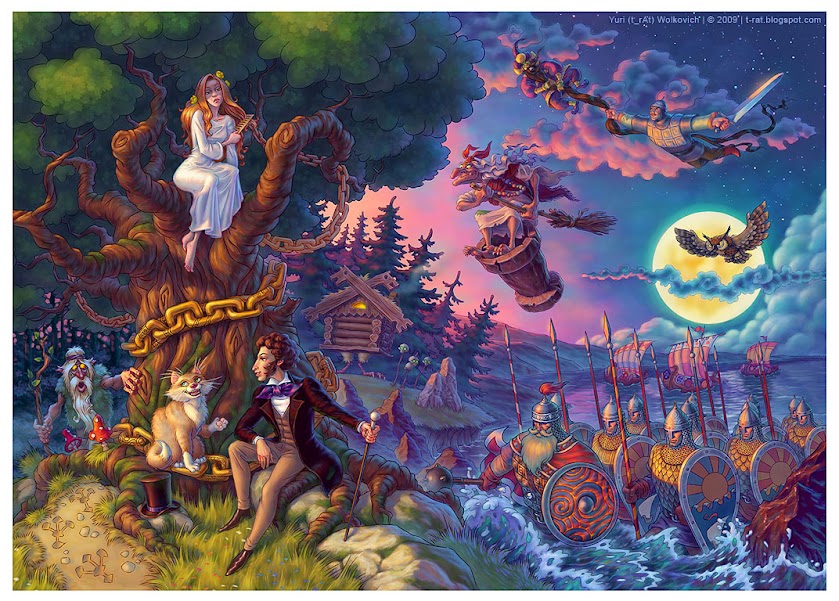
By E-chan. I’d like to introduce you to one of the most well-known Russian poems. It’s actually just a prologue to an epic poem Ruslan and Ludmila by Alexander Pushkin. However this prologue became very famous in itself. Nowadays virtually every child knows it, many people remember it by heart. It’s a very beautiful poem that describes a fictional land full of wonders and makes references to some fairy-tales and other poems. It’s definitely worth knowing if you are interested in Russian culture. There are quite a lot of old-fashioned and poetic words, so don’t bother to learn them all. My goal is to introduce you to this poem, not to teach you all the vocabulary. On the other hand, if one day you recite this poem to some Russian friend or relative, I’m sure they will be immensely impressed ;-) Folklore First, let’s look at some folklore elements mentioned in the poem. Лукомо́рье (Lukomorye) – a fictional land on the edge of the world, literally “a curved sea-shore...